
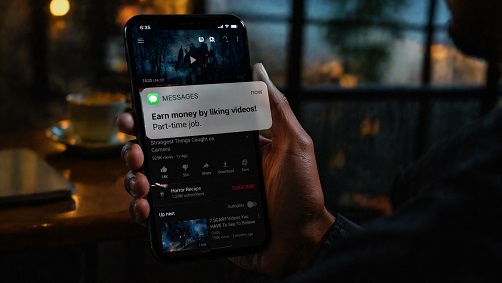
"Hello! We are an international digital marketing agency. We are hiring part-time workers to increase the popularity of YouTube bloggers. You just need to like 3 videos, send us a screenshot, and earn ₹150 instantly..."
1. The Bait (Earning Trust)
The scam is initiated via a random WhatsApp or SMS message. They offer you a job that requires zero skills, no investment, and pays instantly. They ask you to open a YouTube link, "like" the video, subscribe to the channel, and send a screenshot as proof.
- You think, "What's the harm? It's just a YouTube like." You send the screenshot.
- To your absolute surprise, the scammer immediately asks for your UPI ID and transfers ₹150 or ₹200 to your bank account.
- This initial payout is the ultimate psychological hook. It destroys your skepticism. You now believe this is a genuine company paying real money.
2. The Shift to Telegram (The Deception)
Once trust is established, the "HR Recruiter" on WhatsApp tells you that to receive more tasks and higher payouts, you must download Telegram and contact the "Receptionist" or "Tutor."
Why Telegram?
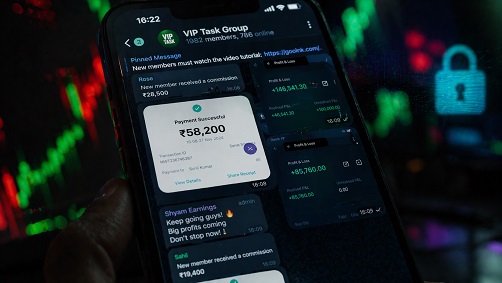
Telegram offers greater anonymity for scammers. Once you join their "VIP Task Group," you will see hundreds of other members (who are actually bots or the scammers themselves) constantly posting screenshots of receiving huge payouts like ₹10,000 or ₹50,000. This creates extreme FOMO (Fear Of Missing Out) and social proof.
3. The "Prepaid Task" Extortion (Sunk Cost Fallacy)
For the first two days, you make a few hundred rupees doing simple YouTube tasks. On the third day, the "Tutor" introduces a "Merchant Task" or "Prepaid Task" .
They explain that to earn a 30% commission, you must first "recharge" or invest your own money on a fake crypto or merchant website.
- Level 1: You pay ₹1,000. They immediately return ₹1,300. Your confidence peaks.
- Level 2: You pay ₹5,000. But this time, they say it's a "Combo Task." To withdraw your ₹6,500, you MUST complete the second part of the combo by paying ₹20,000.
- The Trap: If you hesitate, they say your funds are frozen. If you make a "typo" entering the withdrawal code, they demand a ₹50,000 "penalty" to unfreeze your account.
- You keep borrowing and paying, desperately trying to recover your initial investment, until you are completely bankrupt.
4. Where Does Your Money Go?
The money you transfer for the "Prepaid Tasks" goes into shell bank accounts (Mule Accounts) set up across India. Scammers immediately convert this INR into Cryptocurrency via peer-to-peer (P2P) networks, making it nearly impossible for local police to reverse the transaction once the crypto leaves the country.
5. Red Flags & Your Action Plan
The Ultimate Red Flag: No legitimate digital marketing company or YouTuber pays people via Telegram to like videos. Furthermore, any job that requires you to pay money to earn money is a 100% confirmed scam.
What to do if you have been scammed?
- Mistake 1: Stop paying! Do not pay any "penalty" or "tax" to unfreeze your funds. They will never return your money.
- Mistake 2: Do not exit or delete the Telegram group. Take screenshots of the chat, the UPI IDs, and the bank account numbers they provided.
- The Solution: Dial the National Cyber Crime Helpline at 1930 immediately. Follow up by registering a formal complaint at cybercrime.gov.in .