
Blueprint 2026: The Engineering of a $5 Trillion Economy
Budgets are usually judged by "What got cheaper?"—a cheaper phone or lower income tax. But if you look closely at Budget 2026-27, the real story isn't the tax slabs. It's the silent, massive engineering work happening in Railways, Energy, and Rural India. This is not a budget for the next election; it is a budget for the next generation.
In Part A of the Budget Speech , the Finance Minister laid out three core duties ("Kartavyas") to accelerate growth: Economic Growth, Youth Capacity Building, and Sabka Saath, Sabka Vikas.
This sounds like political rhetoric until you open the Expenditure Profile documents. That's where the money talks. The government is shifting gears from "Spending on Freebies" to "Building Assets." This shift from Revenue Expenditure to Capital Expenditure (Capex) is the single most important signal for long-term investors.
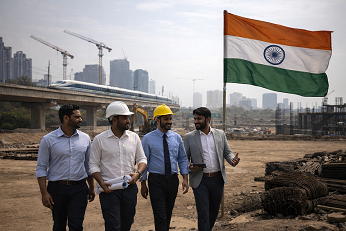
Building New India
The "Capex Multiplier" Effect
Before we dive into sectors, you must understand one economic concept: The Multiplier Effect.
When the government gives ₹100 as a free subsidy, it adds ₹95 to the economy (some is saved). But when the government spends ₹100 on building a Bridge or a Railway Track (Capex), it adds approximately ₹250 to ₹350 to the GDP over the next few years. Why?
- It creates jobs for engineers and laborers.
- It creates demand for steel and cement.
- It reduces logistics costs for businesses forever.
Budget 2026 is heavy on this "Good Spending."
Pillar 1: Infrastructure & Safety (Railways 2.0)
You cannot have a developed economy with outdated logistics. The Expenditure Profile (Vol 1, Page 320) reveals a critical data point: ₹11,000 Crore allocated to the "Rashtriya Rail Sanraksha Kosh" (RRSK).
This fund is specifically for safety—track renewals, bridge repairs, and removing unmanned crossings.
The "So What?" for the Economy
This isn't just about safety; it's about speed. Indian freight trains average 25-30 kmph because the tracks are old and congested. When you automate signaling (Kavach system) and fix tracks:
- Freight trains can run at 50-60 kmph.
- Logistics cost drops from 14% of GDP to 8-9% (Global Standard).
- Indian manufacturing becomes cheaper than Vietnam or Bangladesh.
FinKinetic Pro Tip: Look Beyond "Coach Makers"
Retail investors rush to buy stocks of companies making Vande Bharat coaches. But the real, sustained order book is with companies doing the "boring" work: Track Laying, Electrification, and Signaling Automation. Dig deeper into the order books of companies like RVNL, IRCON, and Titagarh.
Pillar 2: The Rural Consumption Engine
India's growth story is incomplete without its villages. The budget allocates a massive ₹1,40,528 Crore to the Ministry of Agriculture ( AllSBE, Page 3 ).
Why does this matter to a city investor? Because rural India buys 40% of the FMCG products and 50% of the two-wheelers sold in this country.
The Revival Cycle:
For the last 2 years, rural consumption was weak due to erratic monsoons. This massive allocation, combined with credit support for farmers, is designed to put cash in their hands.
When a farmer gets money, he buys a tractor (M&M stock goes up), builds a house (Cement/Steel stocks go up), and buys better clothes/soap (FMCG stocks go up).
Pillar 3: Energy Security & The Green Transition
A hidden gem in the AllSBE document is the allocation of ₹24,123 Crore to the Department of Atomic Energy.
As India grows to a $5 Trillion economy, our hunger for power will double. We cannot rely solely on coal (pollution) or Solar (doesn't work at night). Nuclear energy provides the "Base Load" power essential for factories to run 24/7.
The Bio-Fuel Opportunity
The exemption of Excise Duty on Compressed Biogas (CBG) blending is not a small tweak. It is the start of the "Satat" initiative to turn agricultural waste into fuel.
- The Winner: City Gas Distribution companies (IGL, MGL) will have cheaper input costs.
- The Loser: Oil Import dependency decreases (Good for the Rupee).
Strategic Analysis: The "China Plus One" Angle
While not explicitly mentioned as "China" in the speech, the reduction of customs duties on leather/footwear inputs and the focus on "Make in India" for mobile components is a clear geopolitical move.
Global companies are looking for a factory outside China. By fixing logistics (Railways) and lowering input costs (Customs Duty cuts), Budget 2026 is effectively rolling out the red carpet for manufacturing.
But what about the Taxes?
Growth needs to be funded by taxes. While the infrastructure story is great, the new tax rules might impact your personal savings. Read our Deep Dive into the Tax Changes here .
Actionable Strategy: How to Invest in This Growth?
Knowing the macro picture is useless if you don't know how to act on it. Here is how you can align your portfolio with the "Viksit Bharat" theme.
1. The "Aggressive" Portfolio (High Risk, High Reward)
Focus on small-cap companies in the
Railway Ancillaries
and
Defense
sectors. These companies are directly getting the government orders.
Warning: These stocks are volatile. Allocation: 10-15%.
2. The "Balanced" Portfolio (Medium Risk)
Focus on Banking and Power Financing stocks (like REC/PFC). Why? Because all this infrastructure needs loans. When the country builds roads and dams, banks earn interest.
3. The "Defensive" Portfolio (Low Risk)
Focus on Rural FMCG . Even if the infrastructure delays, people in villages will still buy soap, biscuits, and hair oil. With the ₹1.4L Cr agriculture push, these companies will show steady volume growth.
Final Verdict: The Long Game
Based on the data, this budget is Fiscal Prudence meets Aggressive Capex . The government is resisting the temptation to spend money on short-term populist schemes and is instead investing in long-term assets.
For a trader, this budget might be boring (no big surprises). But for an investor looking at a 5-10 year horizon, this budget confirms that the "India Growth Story" is being engineered on a solid foundation of concrete and steel, not just paper promises.
How does this affect your Wallet?
While the country grows, make sure your savings grow too. Check the new tax impact.
Read Tax Analysis